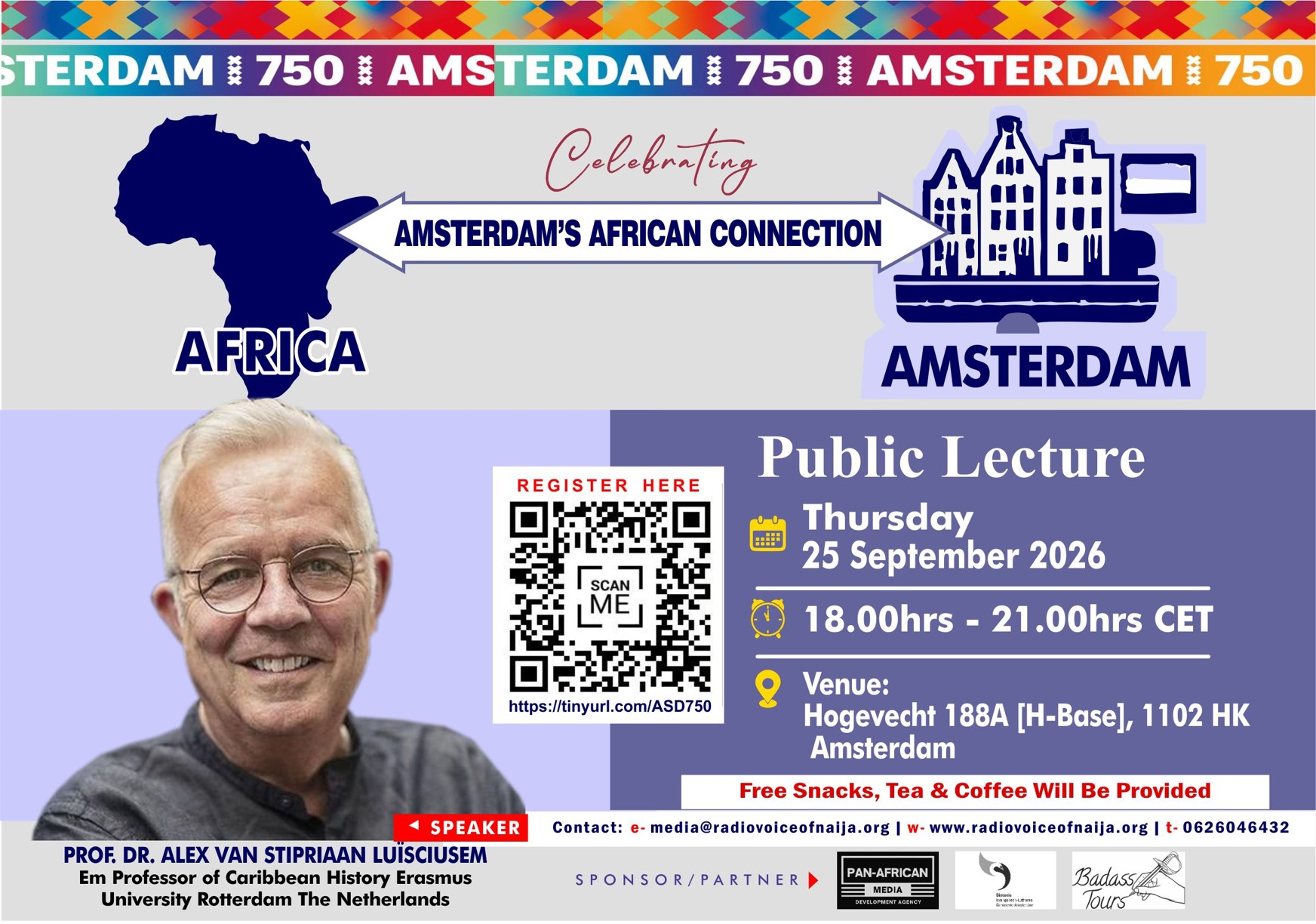
Cultural Heritage-750 years Amsterdam
This year (2025), the city of Amsterdam celebrated 750 years of it founding, and celebrate such a momentous occasion, we thought of putting an African twist on the anniversary by doing something special to highlight Africa’s relationship with the city during the past nearly eight centuries. This gave birth to the Heritage Month project. We organised two events to commemorate the occasion; namely the African Heritage Tour which explored Amsterdam’s long, often hidden connections with Africa and the Afrodiaspora – further details are covered in this report. After that was a public lecture “Amsterdam’s African Connection” by Prof. van Stipriaan, which highlighted the deep, long-standing ties between Amsterdam. The event aimed to foreground African histories and contributions which traditionally are often overlooked in mainstream narratives. Further details are in this report. Our special gratitude goes to Elianne Schultz and Martin Teunissen of the Diaconie Evangelisch-Lutherse Gemeente Amsterdam for helping to sponsor these two activities. It was when we were desperately looking partners to realise this project. We also thankful to Lucia Martis of Stichting Profor for opening her doors to host the lecture. December, 2025 Pan-African Media Dev. Agency
2. Project Overview
This project was designed to commemorate Amsterdam’s 750th anniversary by engaging African migrant and Afro-Caribbean diaspora communities in Amsterdam Southeast to reflect on the historical relationship between Amsterdam and the African continent beyond the clichéd slavery-only narrative. The programme included guided heritage tours and a public lecture with storytelling. Both activities highlighted Amsterdam’s colonial history, multicultural identity, and the long-standing presence and contributions of African communities.
This initiative also aligned with the Amsterdam Municipality’s area priorities of:
• Promoting inclusive historical education
• Strengthening social cohesion and cultural understanding
• Encouraging community participation and civic identity
Relevance to Amsterdam @ 750 / Municipal Priorities
Amsterdam Southeast is home to vibrant African communities whose stories are essential to the city’s evolving narrative but are often underrepresented in official heritage commemorations.
This project was justified by the need to bridge historical knowledge gaps by connecting African residents to the city’s past. It was also important to celebrate Amsterdam’s 750th anniversary by included other least represented people groups. Furthermore, it was necessary to foster a deeper sense of belonging among African migrants and Afro-Caribbeans within the city’s identity. The project also created opportunities for cross-cultural dialogue and civic engagement
3. Activity Highlights
3.1 African Heritage Walking Tour – 20 September 2025
Description:
The African Heritage Tour explored historically significant sites in central Amsterdam while highlighting stories of African and Afro-diaspora individuals whose lives intersected with the city across centuries.
Led by Elizabeth of Badass Tours, the tour highlighted significant individuals whose lives intersected with the city across four centuries—from 17th-century Africans like Peter and Lysbeth and diplomat Don Miguel de Castro, to Surinamese and African American cultural icons such as Kid Dynamite, Albert Helman, Nina Simone, and Josephine Baker.
The tour contextualised these stories within the broader influence of the Dutch West India Company (WIC) and Dutch East India Company (VOC), whose trade, enslavement systems, and global networks shaped early African presence in Amsterdam. Participants engaged in discussions about fragmented histories, the difficulty of tracing African origins, and the importance of reclaiming African knowledge, identity, and cultural narratives.
Overall, the tour strengthened awareness of the deep historic ties between Amsterdam and Africa, elevated overlooked diaspora histories, and fostered a sense of pride, reflection, and community among participants.
The guide emphasized:
· History becomes meaningful through personal stories.
· Each tour stop focused on an individual whose life intersects with Amsterdam’s African or diasporic history.
· The historical narrative included both direct African connections and diaspora connections (with subjects from Suriname, Caribbean, African Americans, South Africa).
The focus was primarily on people shaped by the Dutch West India Company (WIC) and, to a lesser extent, the Dutch East India Company (VOC).
Number of participants:
In total ten (10) persons participated in the tour.
Key takeaway:
Based on the full African Heritage Walking Tour, the main takeaway may be expressed this way:
The tour revealed that Amsterdam has a deep, long-standing African and Afro-diasporic history, much of which is hidden in plain sight—in its streets, buildings, art, and community stories. By focusing on real individuals from different eras, the tour showed that African people were not only present but actively contributed to Amsterdam’s cultural, economic, and social development from the 1600s to today.
Participants left with a stronger sense of belonging, pride, and historical connectedness, recognising that African heritage is an integral part of Amsterdam’s story—not an addition to it.
3.2 Public Lecture – 16 October 2025
Speaker:
Emeritus Prof. Dr. Alex van Stipriaan Luïscius
Attendance:
There were approximately twenty (20) participants in attendance.
Key takeaway:
The lecture demonstrated that Africa has been deeply intertwined with Amsterdam’s history for over 400 years, shaping the city’s economy, culture, identity, and population far more than most people realise. Prof. Alex van Stipriaan showed that Africans were present in Amsterdam from the 1500s onward—not only as enslaved or marginalized people, but as sailors, artisans, diplomats, soldiers, cultural figures, and community members.
He argued that recognising Africa’s role is essential to understanding Amsterdam’s 750-year story and to building an inclusive historical narrative that acknowledges both the painful legacies of slavery and the rich cultural contributions of African and Afro-diasporic communities. Participants left with a deeper appreciation of how Amsterdam would not be the city it is today without Africa, historically and in the present.
4. Main Results & Impact
The main impact and results of the heritage month may be summarised as follows:
1. Community Impact
- Brought together residents from diverse African backgrounds and local allies, fostering a sense of shared experience and belonging.
- Created new relationships between participants, organisers, and heritage professionals.
- Strengthened neighbourhood cultural participation by offering accessible, community-rooted programming.
2. Learning Outcomes
- Participants gained new knowledge about African presence in Amsterdam from the 1500s to today.
- The tour and lecture clarified misconceptions about African history, Dutch colonial involvement, and diaspora contributions.
- Attendees learned about specific historical figures (e.g., Peter & Lysbeth, Don Miguel de Castro, Kid Dynamite) and how their lives intersect with modern Amsterdam.
- Increased awareness of archival challenges, cultural memory, and how history is constructed.
3. African Visibility
- Both activities made African heritage visible within the broader Amsterdam 750 celebrations.
- It also highlighted the contributions of African and Afro-diasporic communities to Amsterdam’s historical and cultural development.
- To an extend, it also built public visibility for local African organisations, performers, and cultural storytellers.
- The lecture recordings and social media promotion extended the reach beyond the physical events.
4. Cultural Understanding
- The heritage month activities deepened the understanding of Africa’s long-standing ties to Amsterdam’s trade, migration, art, and everyday life.
- It also provided space for dialogue about identity, colonialism, memory, and shared histories.
- And it also showcased African cultural expressions (e.g., Ugandan performance and diaspora histories) in an educational setting.
5. Identity & Empowerment
- Through the events participants, felt affirmed seeing their African heritage recognised as part of Amsterdam’s official history.
- Participants felt that both activities validated the importance of African perspectives in the city’s heritage narrative.
6. Social Cohesion
- Both events brought together people across ages, nationalities, and backgrounds, strengthening intercultural bonds.
- The shared learning space created opportunities for constructive conversations and trust-building.
- Furthermore, the events facilitated collaboration between community leaders, cultural organisations, and academic partners.
- Encouraged residents to see African and diaspora identities as integral parts of the city’s social fabric.
6. Conclusion - Overall Success, Lessons Learned & Recommendations
1. Overall Success
The heritage activities were highly successful in meeting their cultural, educational, and community goals. The African Heritage Walking Tour and the Public Lecture “Amsterdam’s African Connection” both attracted strong participation and generated meaningful dialogue. Participants gained new historical knowledge, developed a deeper appreciation of African contributions to Amsterdam’s identity, and felt strengthened in their cultural pride and sense of belonging.
The project significantly increased the visibility of African heritage within the context of the Amsterdam 750 celebrations. Collaboration with partners such as Badass Tours and local performers added depth, richness, and authenticity to the project.
2. Lessons Learned
a) Early venue arrangements are essential.
Securing appropriate and affordable venues for lectures proved challenging. Earlier planning and outreach to multiple institutions can reduce logistical pressure.
b) Registration management is important for limited-capacity events.
Both the walking tour and lecture required controlled participant numbers. Tools like Google Forms and Eventbrite helped, but clear communication and a waiting list system would improve efficiency.
c) Heritage content requires balance between accuracy and accessibility.
Participants appreciated academic depth, but also needed relatable storytelling. The combination of scholarly insight and community dialogue worked well and should be continued.
d) Cultural performances enrich educational activities.
The Ugandan dance segment added energy and identity to the lecture. Embedding culture alongside history strengthens audience engagement and emotional impact.
e) Participants value opportunities for discussion.
Both events generated significant conversation. More time was required for Q&A, and networking.
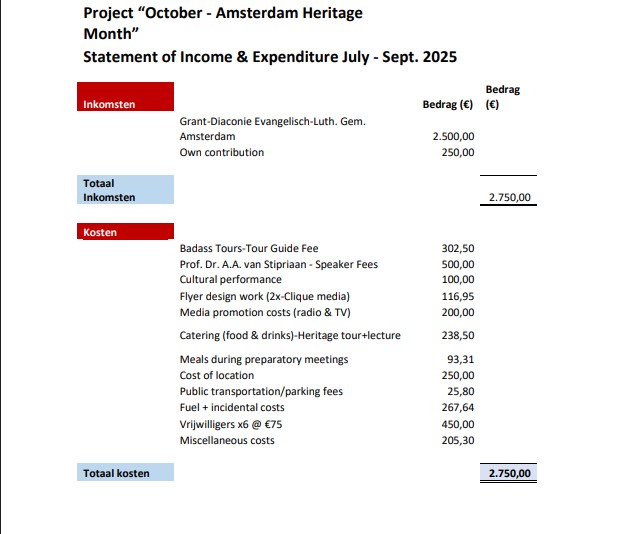
5. Financial Summary
7. Appendices
I. Photos
II. Flyers / promotional materials
III. Links to recordings /photo archive
III. Links to recordings / Photo archive
1. YouTube - The African Heritage Tour - By Amsterdam's Afro diaspora
2a. YouTube - Lecture-Part 1 Amsterdam's African Connection -Heritage Month @750 Years